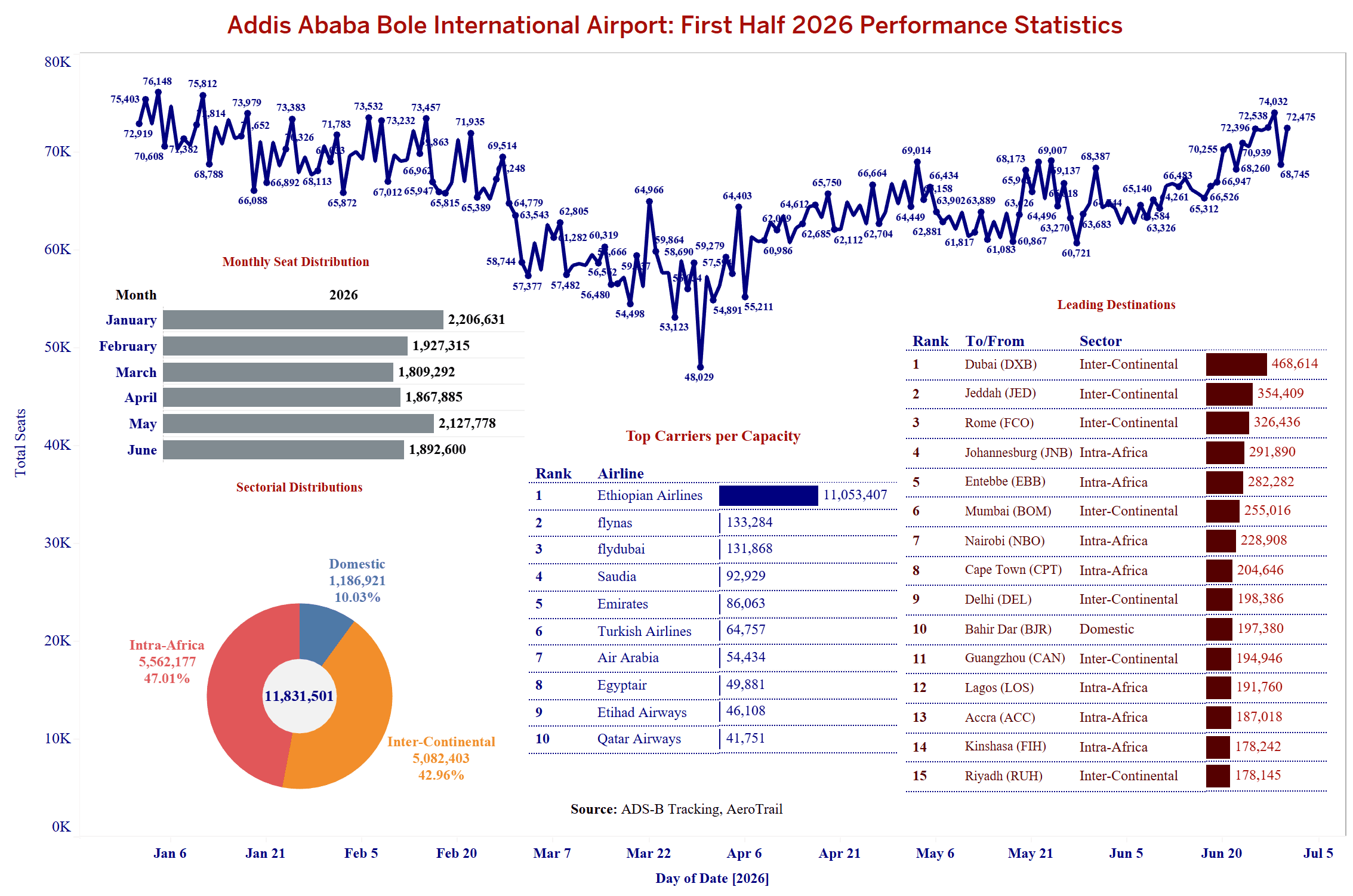
Addis Ababa Bole International Airport H1 2026 Performance: How Africa's Premier Aviation Hub Continues to Redefine Continental Connectivity
Introduction
The African aviation industry is undergoing a profound transformation. While many airports continue to recover from the disruptions of the COVID-19 pandemic and navigate persistent challenges such as rising operating costs, aircraft delivery delays, geopolitical tensions, and supply chain constraints, a handful of airports have emerged as continental leaders. Among them, Addis Ababa Bole International Airport (ADD/HAAB) continues to distinguish itself as one of Africa's most strategically important aviation gateways.
According to AeroTrail Africa's H1 2026 airline seat capacity analysis, Addis Ababa Bole International Airport recorded 11,831,501 available airline seats during the first six months of 2026. This performance ranked the airport as Africa's third busiest airport by scheduled airline seat capacity, behind only Cairo International Airport (CAI) in Egypt and O.R. Tambo International Airport (JNB) in South Africa.
However, the significance of these statistics extends well beyond rankings. The data demonstrates the remarkable success of Ethiopia's long-term aviation strategy, the unparalleled dominance of Ethiopian Airlines, and Addis Ababa's growing importance as…
Go Premium
This article is available to subscribers only.
Subscribe to unlock full access to all premium content, including in-depth articles and weekly aviation industry insights.
- ✓Full access to all articles and weekly trails
- ✓Exclusive data analytics dashboards
- ✓Early access to new content
- ✓Priority support