ABOUT US
AeroTrail is a premier aviation consultancy specializing in comprehensive market research, advanced data analytics, and strategic modelling solutions. Founded by a group of passionate transportation experts, our company is committed to acquiring, analysing, modelling and simulating data critical to the domestic, regional, and continental aviation markets.
Market Research
Qualitative & quantitative analysis
Data Analytics
Advanced modeling & simulation


AFRICA AVIATION TRAILS
Stay informed with our latest aviation industry analysis

Route & Connectivity: Week 42, 2026
The route trail highlights AFRICA’s expanding air connectivity through new services, increased frequencies and prospective market entries. Jubba Airways resumed flights to Hargeisa, SOMALILAND, while Air Algérie launched five routes from Algiers to destinations across AFRICA and CHINA. Wings introduced scheduled cargo services to BELGIUM and FRANCE, supporting Tunisian industrial exporters, while TAAG Angola Airlines plans to connect Luanda with Dakar and Praia. EgyptAir and Brussels Airlines are expanding links to Cairo. Other developments include proposed routes involving BOSNIA AND HERZEGOVINA, SOUTH SUDAN and LIBERIA, seasonal capacity increases by Emirates, and security-related suspensions affecting Israeli carriers’ planned services to MOROCCO.
Airline Fleet trails: Week 42, 2026
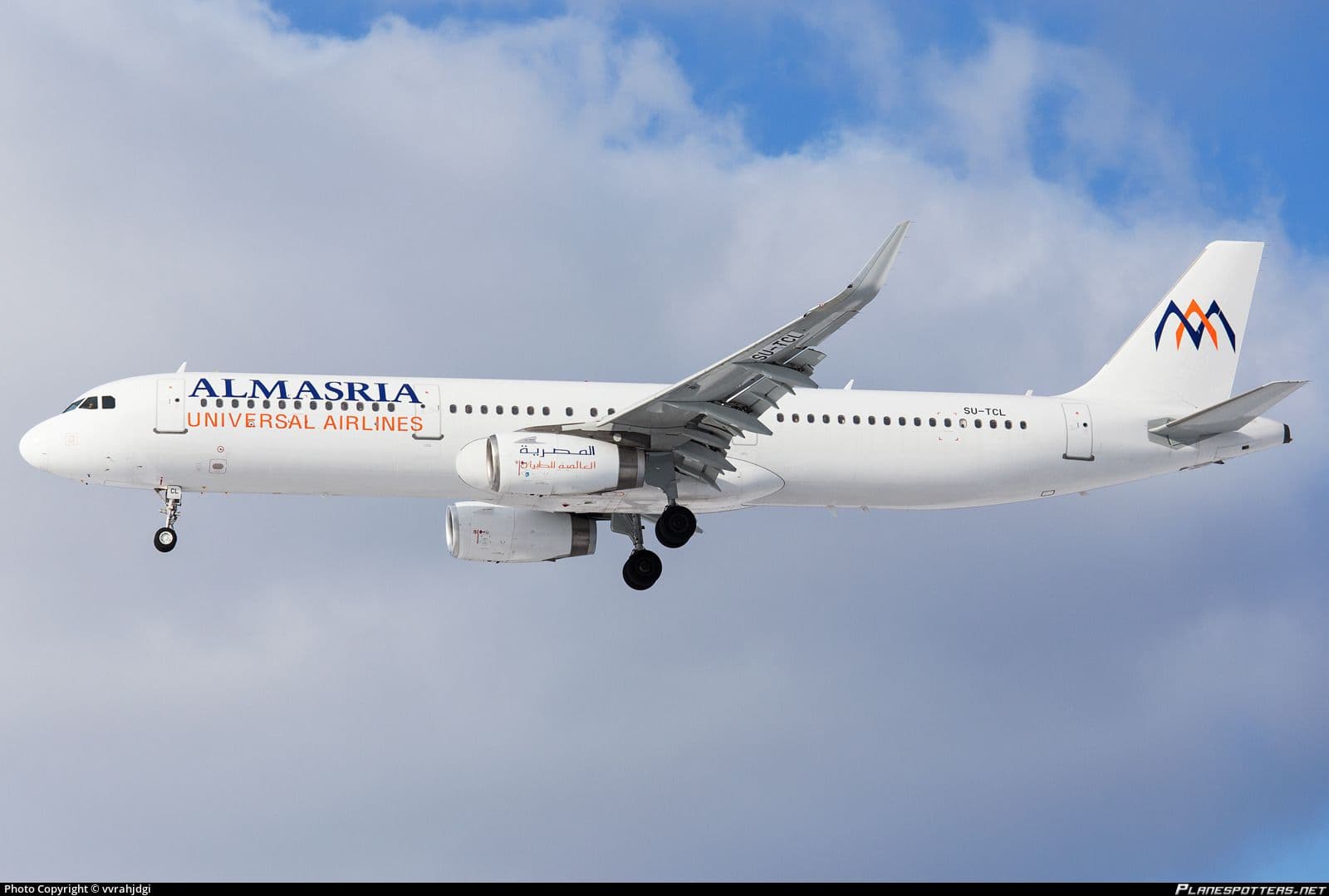
The fleet partnership and deployment trail highlights aircraft acquisitions, fleet modernisation and enhanced connectivity across AFRICA. AlMasria Universal Airlines and Royal Air Maroc received an Airbus A321-231(WL) and an Embraer ERJ-190AR, respectively, while TANZANIA-based Sindbard Air added an Embraer EMB-120ER freighter to support cargo operations. NIGERIA’s Air Peace is preparing to introduce the Boeing 737-900ER, potentially becoming the first African operator of the variant. Meanwhile, Emirates will deploy its Airbus A350 on one daily MAURITIUS service from November 2026, and KENYA received modernised MD500 military helicopters through trilateral cooperation with the REPUBLIC OF KOREA and the UNITED STATES.

Infrastructure & Finance Trails: Week 42, 2026
AeroTrail’s latest industry trail highlights investment, financial resilience and infrastructure modernisation across AFRICA. MOROCCO is advancing airport digitalisation through automated baggage-drop systems and plans a US$239 million sustainable aviation fuel facility at Nador West Med. ESWATINI is seeking investors for a proposed airport-based Special Economic Zone, while Air Cairo has allocated US$100,000 to support air traffic controller training. In KENYA, the Kenya Airports Authority is reviewing commercial rates to boost non-aeronautical revenue. Meanwhile, SOUTH AFRICA’s South African Airways has secured a government guarantee, and NIGERIA’s United Nigeria Airlines is pursuing commercial paper financing to support expansion.

Aviation Agreements Trails: Week 42, 2026
AeroTrail’s partnership trail highlights initiatives strengthening aviation safety, connectivity, skills development and commercial cooperation across AFRICA. SOMALIA partnered with IATA to recognise international operational and ground-handling safety audit standards, while Air Côte d’Ivoire and Air France introduced reciprocal codesharing between Paris and Abidjan. KENYA and the UNITED KINGDOM agreed to recognise aviation security measures to streamline baggage transfers. EGYPT and SLOVENIA are advancing air transport negotiations, while Africa CDC and Ethiopian Airlines are supporting participation in a continental public health conference. Other developments include GABON’s aviation security system and GHANA’s crew-training partnership involving PassionAir.
LATEST ARTICLES
Addis Ababa Bole International Airport H1 2026 Performance: How Africa's Premier Aviation Hub Continues to Redefine Continental Connectivity
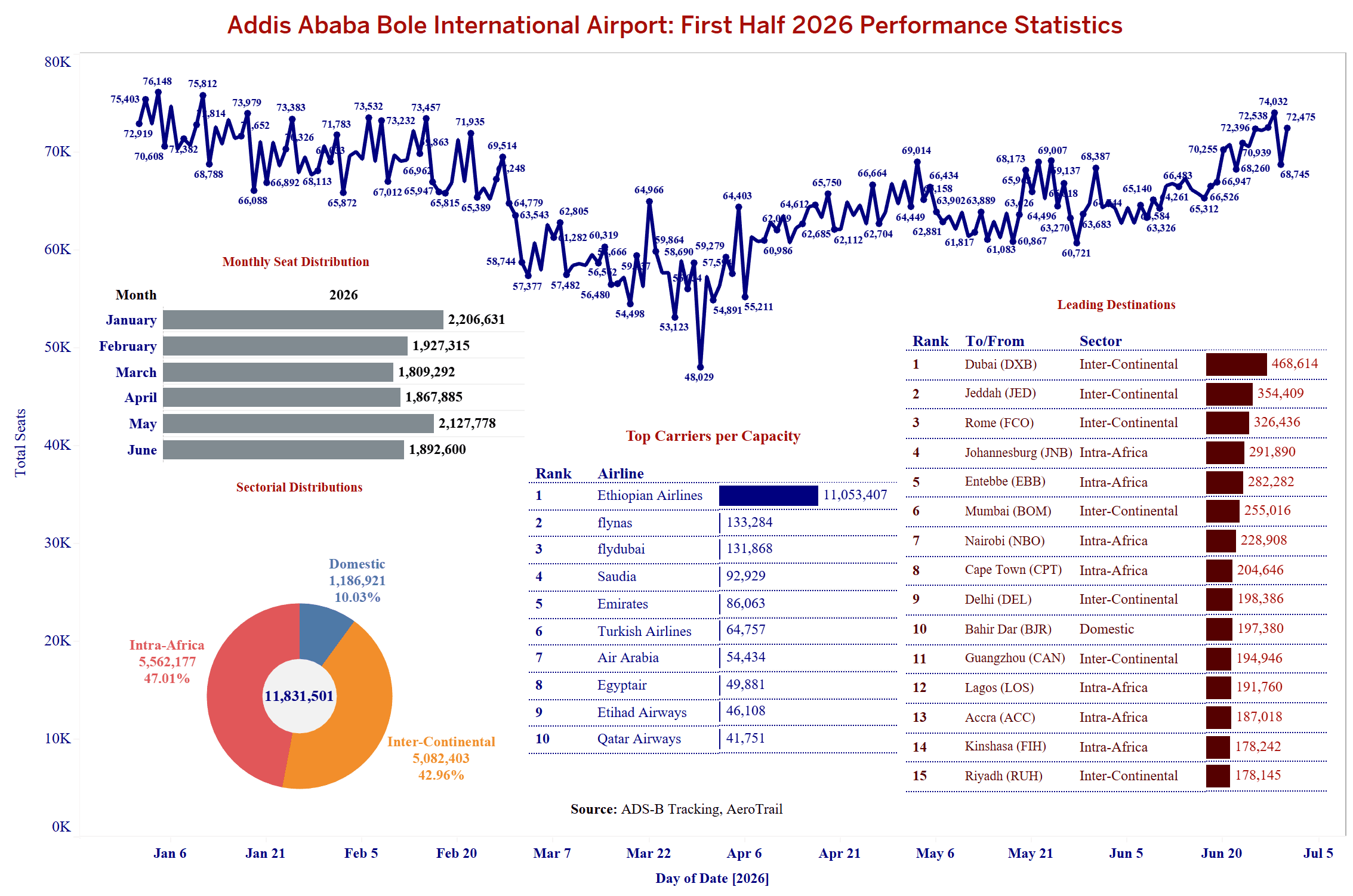
Addis Ababa Bole International Airport (ADD) recorded 11.83 million seats in H1 2026, ranking as Africa’s third busiest airport and top intra-African hub. Driven by Ethiopian Airlines—which held 93.4% of total capacity—the airport averaged over 65,000 daily seats, led internationally by Dubai and regionally by Johannesburg.
Morocco’s Leading Gateways: Q1 2026 Airline Capacity Analysis of Mohammed V International Airport (CMN/GMMN) and Marrakech Menara Airport (RAK/GMMX)
Morocco’s aviation landscape saw a notable shift in Q1 2026, with Marrakech Menara Airport overtaking Mohammed V International Airport as the country’s busiest airport by seat capacity, driven by strong European leisure demand and low-cost carrier expansion. While Casablanca maintained its role as a major intercontinental hub with significant intra-African connectivity, Marrakech emerged as a high-growth, tourism-focused gateway with rapidly increasing capacity and a predominantly Europe-oriented network. The analysis highlights contrasting trends—declining capacity in Casablanca versus steady growth in Marrakech—alongside differences in network structure, airline competition, and fleet deployment. Overall, the findings reflect a broader structural shift in Morocco’s aviation sector, where leisure-driven traffic is increasingly shaping capacity dynamics alongside traditional hub operations.
Entebbe International Airport (EBB/HUEN): Q1 2026 Airport Capacity Analysis
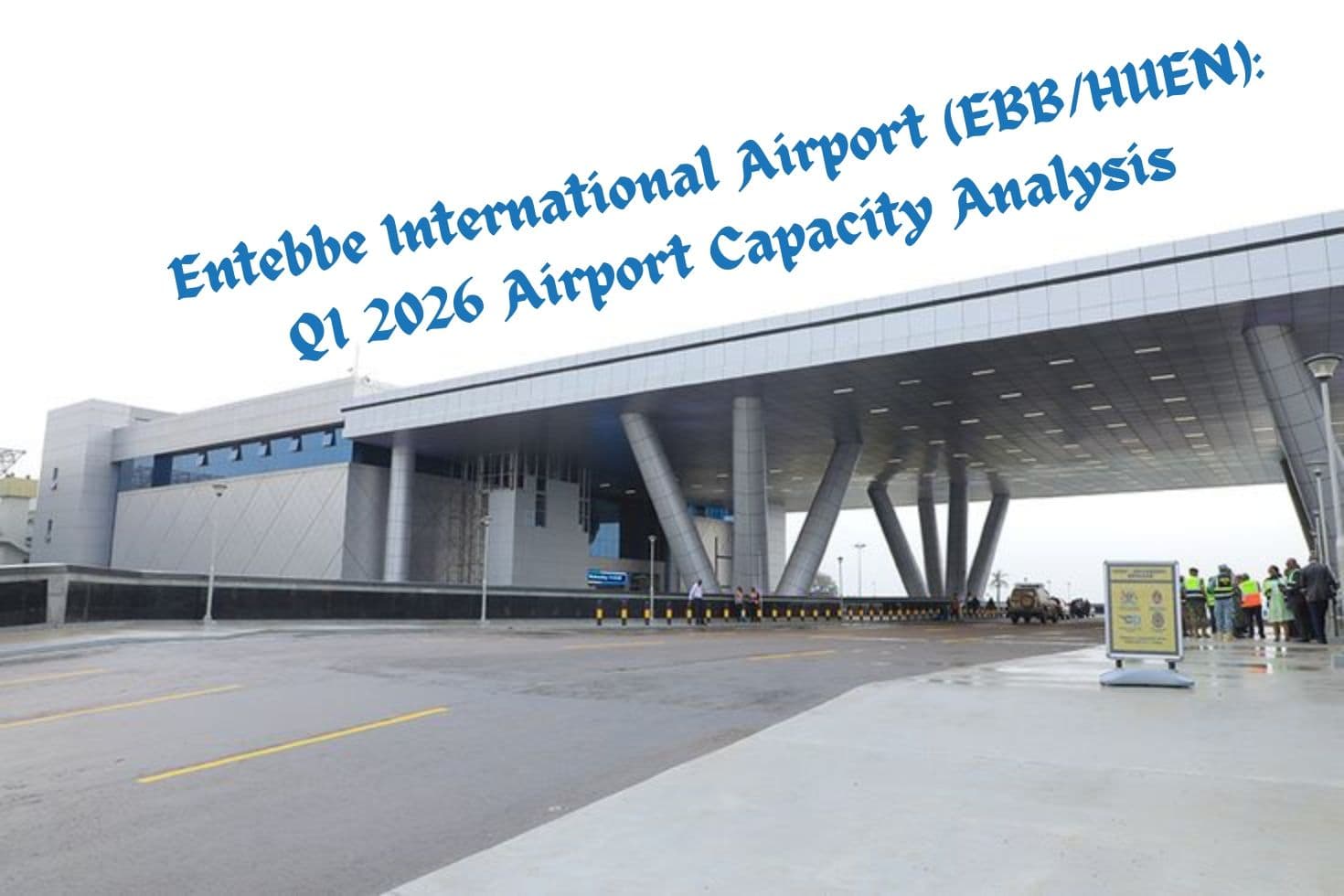
Entebbe International Airport recorded stable but mixed performance in Q1 2026, handling 733,810 seats and 541,454 passengers, with a load factor of 73.8%. While overall passenger traffic declined slightly compared to 2025, growth in transit and domestic segments signaled improving regional connectivity. Cargo volumes, however, dropped significantly, highlighting weaker trade activity despite increased aircraft movements. The airport’s network remained strongly linked to regional hubs such as Addis Ababa and Nairobi, with Ethiopian Airlines and Uganda Airlines leading capacity. Overall, the performance reflects a resilient but transitional phase, with growth opportunities in transit traffic and regional integration, alongside challenges in cargo and long-haul demand.
YearBook Partners